
Missing the 31 January deadline is more common than most people think. Around one million taxpayers filed late last year, and many of them were landlords, contractors and small business owners with complicated affairs rather than people who simply forgot. If you have missed the deadline for your self assessment tax return, the most important thing to know is that acting quickly can make a real difference to how much you end up paying.
This guide explains the penalties HMRC charges, the steps you should take straight away, and how the team at ABM Chartered Accountants can help you get back on track.
What Happens When You Miss the Self Assessment Deadline
For the 2025/26 tax year, the online filing deadline is midnight on 31 January 2027. The same date is also the deadline for paying any tax you owe for that year, along with your first payment on account for the following year if one applies.
If HMRC has not received your return by then, penalties start immediately. Importantly, late filing and late payment are treated as two separate failures, which means you can be charged for both at the same time.
Self Assessment Late Filing Penalties Explained
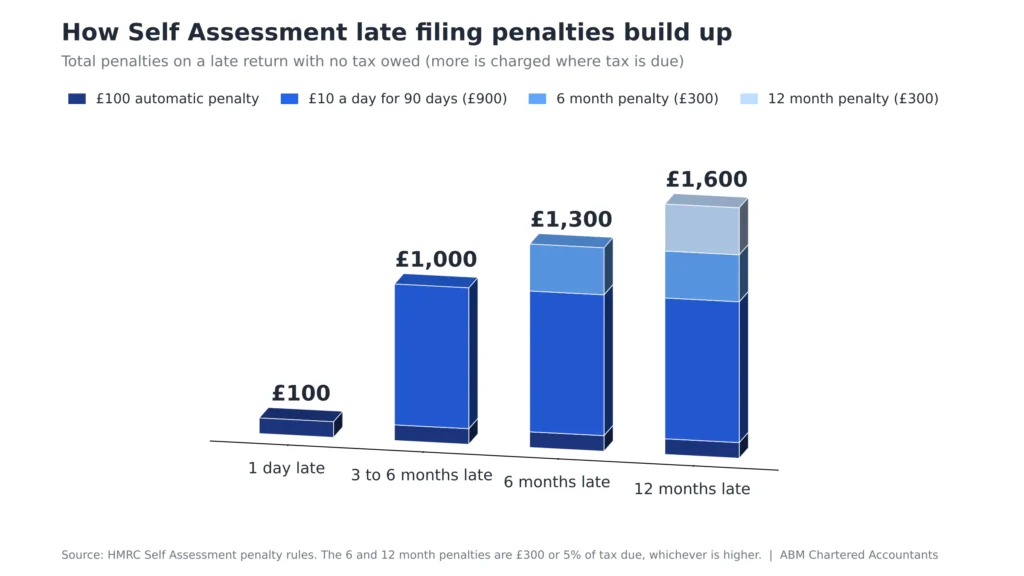
HMRC applies late filing penalties on a sliding scale. The longer your return is outstanding, the more you pay.
- 1 day late: an automatic £100 penalty, even if you owe no tax at all
- 3 months late: £10 for each additional day, for up to 90 days, adding as much as £900
- 6 months late: a further £300 or 5% of the tax due, whichever is higher
- 12 months late: another £300 or 5% of the tax due, whichever is higher, with larger penalties possible where HMRC believes information was deliberately withheld
Left unresolved for a full year, a return with no tax due can still cost £1,600 in penalties. Where tax is owed, the figure can be far higher.
Late Payment Penalties and Interest
If you also have tax to pay, HMRC charges late payment interest from 1 February. The rate is set at the Bank of England base rate plus 4%, and from 24 November 2026 it stands at 8% a year. Interest builds up daily until the bill is cleared in full.
On top of interest, late payment penalties apply. Under the long-standing rules, HMRC charges 5% of the unpaid tax at 30 days, a further 5% at six months and another 5% at twelve months. HMRC is now moving Self Assessment towards a newer model, used alongside Making Tax Digital, which charges 3% at day 15, another 3% at day 30 and then an annual rate of 10% on the outstanding balance. Which rules apply depends on your circumstances and the tax year, so it is worth checking before you assume the cost.
What to Do Next to Limit Penalties
1. File Your Return as Soon as Possible
Filing stops the clock on daily penalties and prevents the six and twelve month charges from being added. Even if you cannot pay yet, submit the return. If some figures are not final, you can use reasonable estimates and amend the return later once you have the correct information.
2. Pay What You Can Now
Interest is charged on the unpaid balance, so every payment you make reduces the amount that grows each day. A partial payment is far better than waiting until you can clear the full bill.
3. Set Up a Time to Pay Arrangement
If you cannot afford the full amount, contact HMRC about a Time to Pay arrangement. In many cases, taxpayers who owe £30,000 or less and have filed their returns can set up a payment plan online. Agreeing a plan before the 30 day point can prevent the first late payment penalty, although interest will still apply to the outstanding balance.
4. Appeal if You Have a Reasonable Excuse
HMRC may cancel a penalty if you had a reasonable excuse for filing or paying late. Examples include serious illness, the death of a close relative, unexpected hospital stays, fire or flood, or a failure of HMRC’s online service. Pressure of work, lack of funds or relying on someone else to file usually do not count.
You normally need to appeal within 30 days of the date on the penalty notice, and you must fix the failure as soon as the excuse ends. A clear, well documented appeal has a much better chance of success.
5. Check Your Records for Wider Issues
A late return is often a sign that your records need attention. Use this as a chance to review income from property, dividends, capital gains and self employment. Errors found now are better corrected by you than discovered by HMRC during an enquiry.
Common Reasons People Miss the Deadline
In our experience at ABM Chartered Accountants, late filing rarely comes down to carelessness alone. The most common causes include:
- Losing access to a Government Gateway account or misplacing a Unique Taxpayer Reference
- Registering for Self Assessment late after starting a new business or letting a property
- Waiting on figures from letting agents, brokers or employers
- Complex capital gains following a property or share sale
- Changes in personal circumstances such as a bereavement or divorce
Understanding why you missed the deadline helps you put the right systems in place so it does not happen again.
How to Avoid Missing the Deadline Next Year
The simplest protection is to file early. You can submit your return from 6 April, straight after the tax year ends, which gives you months to gather documents and plan for the bill. Filing by 30 December also allows tax of up to £3,000 to be collected through your PAYE tax code if you are eligible.
Keeping digital records throughout the year will also become essential as Making Tax Digital for Income Tax expands to more sole traders and landlords. Regular bookkeeping makes quarterly reporting and your annual return far less stressful.
It also makes sense to look at the bigger picture. Many clients who come to us for help with a late return also benefit from a broader review of their finances, including pension contributions, allowances and inheritance tax planning for property and family wealth. Sorting your tax affairs properly today can protect both your income and your estate in the long term.
How ABM Chartered Accountants Can Help
If you have missed the deadline, you do not need to deal with HMRC alone. ABM Chartered Accountants supports individuals, landlords, contractors and business owners from our Canary Wharf office with:
- Preparing and filing overdue tax returns quickly and accurately
- Calculating tax liabilities and identifying allowable expenses and reliefs
- Drafting reasonable excuse appeals against HMRC penalties
- Negotiating Time to Pay arrangements on your behalf
- Ongoing tax compliance so you meet every future deadline
The sooner you contact us, the more options are available to reduce penalties and interest. Speak to our team today and let us take the pressure off.
Frequently Asked Questions
Can HMRC remove the £100 late filing penalty?
Yes, but only if you have a reasonable excuse that HMRC accepts, such as serious illness, bereavement or a problem with HMRC’s online service. You usually need to appeal within 30 days of the penalty notice and file your return as soon as the excuse ends.
Do I still get a penalty if I owe no tax?
Yes. The £100 late filing penalty applies even if no tax is due. However, if you no longer need to complete Self Assessment, you can ask HMRC to withdraw the requirement to file, which may also remove the penalty.
Will filing late increase my chance of an HMRC enquiry?
Filing late does not automatically trigger an enquiry, but repeated late returns and inconsistent figures can draw HMRC’s attention. Filing accurately with the support of a qualified accountant is the best way to reduce that risk.